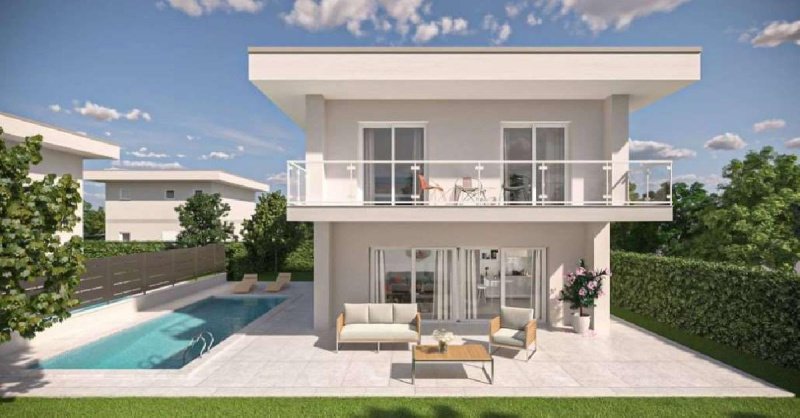
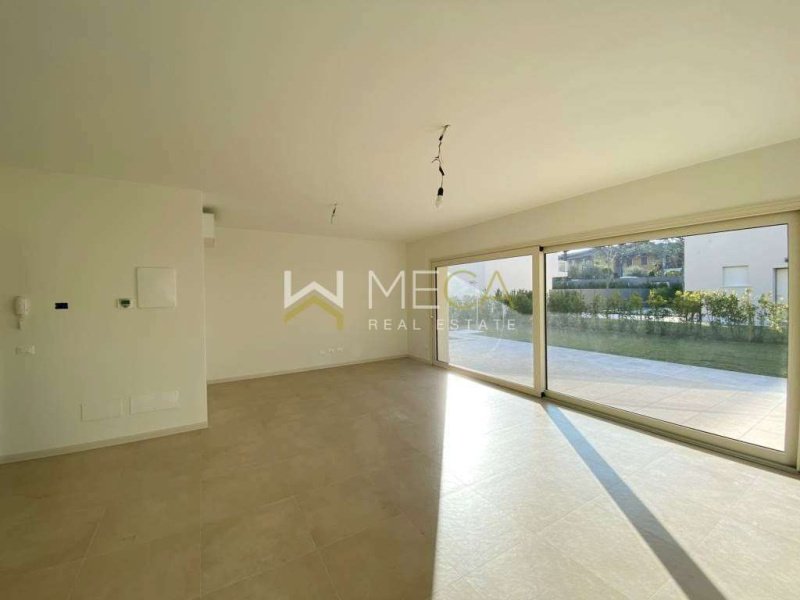
Manerba del Garda, completion of work from May 2025, 400 meters from the 'Romantica' beach, one of the most beautiful beaches on the whole of Lake Garda, offers 2 villas nearing completion with energy class A4 and with swimming pool and private garden of 350 sqm.
Each villa is composed on the ground floor, of 48 sqm, of a spacious living area and open kitchen, external porch of 30 sqm, bathroom; on the first floor, of 42 sqm, two double bedrooms with a 15 sqm terrace, storage room/walk-in closet, bathroom and in the basement of 40 sqmq a spacious storage room/cellar. Two private uncovered parking spaces for each unit. Possible to customize.
Anti-seismic building, anti-burglar system, external coat in Rofix rock wool, PVC windows with triple glazing with three closures, electric aluminum shutters, underfloor heating, photovoltaic system, light-coloured stone stairs.
Monuments and places of interest
San Sivino-Gabbiano pile-dwelling site, included in the UNESCO World Heritage List, as part of the transnational serial site Prehistoric pile-dwelling sites around the Alps. History Legend has it that Manerba was built in devotion to the goddess Minerva. She came to hide in this valley, an important and suggestive center of Valtenesi, where she planted her olive trees (of which she was the protector) and taught many of her arts. A temple was built in her honor, but it was destroyed by the Barbarians.' Many scholars believe that the toponym of Manerba derives from "Minerva arx". Others instead trace the name back to the Cenomani Gauls (the term derives from the union of "mon", meaning man of arms, and "erb", military area). The toponym would indicate, in this case, "a fortified place, residence of the chief": this is plausible given that from the top of the Rocca of the town it was easy to defend oneself from any attack. The presence of man on Lake Garda dates back to prehistory, more precisely to the Late Neolithic (about 4000 BC): under the Rocca, in fact, remains of a Mesolithic village have been found. Since the Lombard era, the area was part of the court of the Monastery of San Colombano del Priorato di Bardolino and of the priory of Solarolo, dependent on the Abbey of San Colombano di Bobbio (PC) and of the great monastic fiefdom of Bobbio; The great monks evangelized the territory, encouraging the expansion of trade, agriculture (especially vines and olives), the fishing system, and culture, introducing important innovations and opening trade routes.
Språk från vilket den automatiska översättningen genererades
Manerba del Garda, fine lavori inizio Maggio 2025, a 400 metri dalla spiaggia 'Romantica', una delle spiagge più belle di tutto il lago di Garda, si propongono 2 ville in fase di ultimazione di classe energetica A4 e con piscina e giardino privato di 350 mq..
Ogni villa è composta al piano terra, di 48 mq, da spaziosa zona giorno e cucina a vista, portico esterno di 30 mq, bagno; al piano primo, di 40 mq, da due camere da letto matrimoniali con terrazza di 15 mq, locale ripostiglio/cabina armadio, bagno e al piano interrato di 42 mq da spazioso ripostiglio/cantina. Due posti auto scoperti di proprietà per ogni unità.
Edificio antisismico, impianto di allarme, cappotto esterno in lana di roccia Rofix, serramenti in PVC con tripli vetri a tre chiusure, tapparelle elettriche in alluminio, riscaldamento a pavimento, impianto fotovoltaico, scale in pietra colore chiaro.
Monumenti e luoghi d'interesse
Sito palafitticolo San Sivino-Gabbiano, inserito nella lista del Patrimonio dell'Umanità dell'UNESCO, nell'ambito del sito seriale transnazionale Siti palafitticoli preistorici attorno alle Alpi. Storia La leggenda narra che Manerba fu eretta in devozione alla dea Minerva. Ella venne a nascondersi in questa valle, importante e suggestivo centro della Valtenesi, dove piantó i suoi ulivi (dei quali era la protettrice) e insegnó molte delle sue arti. In suo onore fu costituito un tempio che peró venne distrutto dai Barbari.' Molti studiosi credono che il toponimo di Manerba derivi da "Minerva arx". Altri invece fanno risalire tale nome ai galli cenomani (il termine deriverebbe dall'unione di "mon", che significa uomo d'armi, ed "erb", zona militare). Il toponimo indicherebbe, in questo caso, "un luogo fortificato residenza del capo": ció è plausibile dato che dall'alto della Rocca del paese risultava agevole difendersi da qualunque attacco. La presenza dell'uomo sul Lago di Garda risale alla Preistoria, più precisamente al Tardo Neolitico (circa 4000 a.C.): sotto la Rocca, infatti, sono stati ritrovati resti di un villaggio del Mesolitico. La zona faceva parte fin dall'epoca longobarda della corte del Monastero di San Colombano del Priorato di Bardolino e della prioria di Solarolo, dipendente dall'Abbazia di San Colombano di Bobbio (PC) e del grande feudo monastico di Bobbio. I grandi monaci evangelizzarono il territorio favorendo l'espansione dei commerci, dell'agricoltura (specie la vite e l'olivo), del sistema di pesca, e della cultura, introducendo importanti innovazioni ed aprendo vie commerciali.
CLASSE ENERGETICA:
Manerba del Garda, Fertigstellung der Arbeiten ab Mai 2025, 400 Meter vom Strand Romantica, einem der schönsten Strände am gesamten Gardasee, entfernt, bietet 2 Villen mit der Energieklasse A4, die kurz vor der Fertigstellung stehen, mit Swimmingpool und privatem Garten von 350 qm.
Jede Villa besteht im Erdgeschoss von 55 qm aus einem geräumigen Wohnbereich und einer offenen Küche, einer Außenveranda von 40 qm und einem Badezimmer. im ersten Stock, 62 qm, zwei Doppelzimmer mit einer 16 qm großen Terrasse, Abstellraum/begehbarer Kleiderschrank, Badezimmer und im Keller ein geräumiger Abstellraum/Keller. Zwei private, nicht überdachte Parkplätze für jede Einheit. Individualisierung möglich.
Erdbebensicheres Gebäude, Einbruchschutzsystem, Außenverkleidung aus Rofix-Steinwolle, PVC-Fenster mit Dreifachverglasung mit drei Verschlüssen, elektrische Aluminium-Rollläden, Fußbodenheizung, Photovoltaikanlage, helle Steintreppe.
Denkmäler und Sehenswürdigkeiten
Pfahlbaustätte San Sivino-Gabbiano, eingetragen in die UNESCO-Welterbeliste, innerhalb der transnationalen seriellen Stätte Prähistorische Pfahlbaustätten rund um die Alpen. Geschichte Der Legende nach wurde Manerba zu Ehren der Göttin Minerva erbaut. Sie versteckte sich in diesem Tal, einem wichtigen und eindrucksvollen Zentrum des Valtenesi, wo sie ihre Olivenbäume pflanzte (deren Beschützerin sie war) und viele ihrer Künste lehrte. Ihm zu Ehren wurde ein Tempel errichtet, der jedoch von den Barbaren zerstört wurde. Viele Wissenschaftler glauben, dass der Ortsname Manerba von Minerva arx abstammt. Andere führen den Namen hingegen auf die Cenoman-Gallier zurück (der Begriff leitet sich aus der Verbindung von mon, was Waffenmann bedeutet, und erb, Militärgebiet, ab). Der Ortsname würde in diesem Fall auf einen befestigten Ort, an dem der Häuptling residierte hinweisen: Dies ist plausibel, da die Stadt von der Festung aus leicht gegen alle Angriffe verteidigt werden konnte. Die Anwesenheit des Menschen am Gardasee reicht bis in die Vorgeschichte zurück, genauer gesagt bis in die Jungsteinzeit (um 4000 v. Chr.): Unter der Rocca wurden tatsächlich Überreste eines mesolithischen Dorfes gefunden. Seit der langobardischen Epoche war das Gebiet Teil des Hofes des Klosters San Colombano des Priorats Bardolino und des Priorats Solarolo und unterstand der Abtei San Colombano von Bobbio (PC) und dem großen Klosterlehen von Bobbio. Die großen Mönche missionierten das Gebiet, förderten den Ausbau des Handels, der Landwirtschaft (vor allem Wein- und Olivenanbau), der Fischerei und der Kultur, führten wichtige Neuerungen ein und eröffneten Handelsrouten.